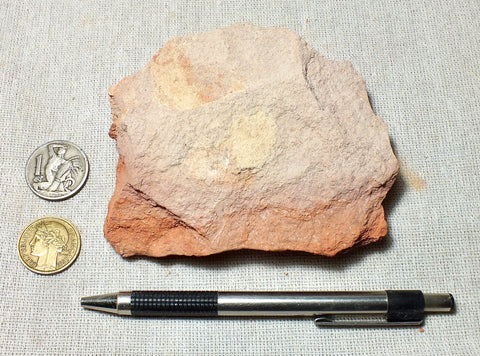
coquina - display specimen of gray oyster shell coquina from the Imperial Formation, Imperial County, California
$ 20.00

Coquina is a sedimentary rock composed almost entirely of shells, marine or non-marine. The southern Imperial Valley was submerged under the Imperial Sea, a shallow arm of the proto-Gulf of California, roughly 3 to 6 million years ago, in the Late Pliocene and Early Miocene. The warm and shallow subtropical waters were home to numerous oyster reefs. As the sea grew shallower, currents and wave action broke up oyster beds and packed the shells tightly into channels. Calcium carbonate has cemented them into dense coquina beds that cap small ridges in the Imperial Formation south of the Coyote Mountains near Ocotillo in Imperial County, California.
The coquina that most students see in the classroom is white, easily collected from extensive beds in Florida. It was widely used as a building stone in 16th to 19th century Spanish colonial structures. In forts, when struck by cannonballs, the porous structure absorbed the blow instead of shattering like hard stone or brick. This gray coquina should make students think.
Select a specimen: When more than one specimen is shown, you can select a particular specimen by telling us what is in the photo with it, a black and silver pen, a black mechanical pencil (it has an eraser), or one of those plus some number of coins, or you can let us make the selection.
Shipping: By Priority Mail or USPS Ground Advantage, whichever is cheaper, unless we find a better rate. Click > here < for shipping rates. Use back button to return to this page.
Making multiple purchases? Click on the "combine shipping" button in the shopping cart. We'll send an invoice with combined shipping. It may not be instantaneous, since a human has to take a look and we might be out in the field during the day. A link in that invoice will bring you back to checkout, no hassle.