calcite - hot pink fluorescent and phosphorescent calcite cleavage rhomb from the Challenger Cave system, Nuevo Leon, Mexico
$ 12.50

Calcite, CaCO3, is an extremely common rock forming mineral. In pegmatites it forms large masses and it makes up some limestones almost entirely. It has a large variety of crystal forms, but these do not include the rhombus-shaped pieces that are sold as “calcite crystals.” The rhombs are produced by cleaving calcite in three directions between rows of atoms.
When calcite is free of impurities and is optically clear, it exhibits double refraction. When it is placed above a line drawn on paper and rotated, the drawn line doubles and becomes single depending on the angle of rotation. These are not clear enough to show double refraction.
Under longwave ultraviolet, these specimens fluoresce a bright hot pink. The first photo shows this fluorescence. The second photo compares the shortwave response of these specimens with others from the same cave system that fluoresce bright cool pink. The third photo shows the shortwave phosphorescent glow, a weak bluish fluorescence and also a blue to white phosphorescence that extinguishes slowly enough to watch. This is described for each specimen below.
In a phosphorescent substance, electrons that absorb energy slowly re-emit it, sometimes glowing for minutes or even hours as they return to their original energy states. Most phosphorescent compounds are fast emitters, however, with lifetimes on the order of milliseconds. You can watch this calcite extinguish as the atoms return to their normal energy state after exciting it with shortwave for a few seconds.
These clean sharp rhombs of colorless calcite are from the Challenger Cave system near Monterrey, Nuevo Leon, Mexico, a famous locality for fluorescent calcite that is now inaccessible. These were mined about five years ago. Once these are gone, that's it.
You will need a strong and well-filtered shortwave lamp to see the bluish fluorescence and phosphorescent decay after the lamp is extinguished. Much of this reaction to ultraviolet is directional - illuminate a rhomb from one direction and the reaction is strong, from another direction and it is not. The cool pink fluorescing specimens we have in stock exhibit stronger phosphorescence.
pencil 3 coins - phosphorescence is weak
pen and pen with one coin - slight phosphorescence
For the pink fluorescence, any filtered ultraviolet flashlight - they are all long wave - will work. For a powerful response, we can recommend a longwave flashlight, complete with battery and charger, sold by Way Too Cool at https://www.fluorescents.com/products-waltz-uv-flashlight.html
For the phosphorescence, we recommend The Triple, complete with batteries and a charger, from Way Too Cool that lets you see fluorescence in short, medium and longwave u/v: https://www.fluorescents.com/products-the-triple.html
If tiny rhombs would be useful in your classroom, let us know and we'll include some, though not of this calcite, for student experimenting and so you can demonstrate the calcium carbonate response to a drop of hydrochloric acid - it fizzes and releases carbon dioxide - without wrecking this example.
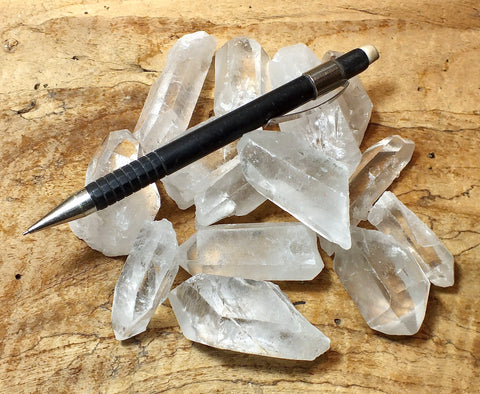
Click on an image to enlarge and click again to further enlarge. The pen is 5" long, for scale. The pencil is 5 1/2" long.
Select a specimen: When more than one specimen is shown, you can select a particular specimen by telling us what is in the photo with it, a black and silver pen, a black mechanical pencil (it has an eraser), or one of those plus some number of coins, or you can let us make the selection.
Making multiple purchases? Click on the "combine shipping" button in the shopping cart. We'll send an invoice with combined shipping. It may not be instantaneous, since a human has to take a look and we might be out in the field during the day. A link in that invoice will bring you back to checkout, no hassle.
Shipping: By Priority Mail or USPS Ground Advantage, whichever is cheaper. Click > here < for shipping rates. See comment at Note! Use back button to return to this page.